Showing posts with label stitch. Show all posts

Friday, 27 April 2018

Learning to Stitch : Five benefits of sewing


An example of layering stitching combined with initials
This week I taught a class of elementary students how to stitch. The students ranged from 5 - 12 years old, and for many this was their first experience of sewing.

There are many reasons why sewing is beneficial....

Pockets designed to hold sticks

1. Hand Eye Coordination 
Sewing with a needle and thread requires coordination, and is a great way for little fingers to learn that fingers help us feel and see. Practicing these skills keeps our brain as nimble as our fingers. 

2. Sewing is Creating
Choosing the colour of material and thread is an act of creativity and it is delightful to see the colour combinations chosen. Getting creative by making these choices means we are engaging our brains in creative thought which is great for the mind. It also assists with boosting our confidence as we learn to trust our choices.

3. Environmental Impact 
Learning to sew on buttons or repair holes saves clothes from being thrown away. According to the Huffington Post a devastating 85% of our clothing ends up in landfill. By lovingly repairing our own clothes we are more likely to continue to wear them and cherish them for longer.  

4. Emotional Wellbeing
Sewing can be therapeutic, which leads to being calmer, happier and relaxed. It encourages a state of mindfulness, awareness or meditation. 

5. A Sense of Accomplishment
The best reason for learning to sew is the sense of accomplishment that comes from creating something handmade. 


Layers of colour

Tree embellishment on pocket : work in progress


Even the teachers got involved and commented on
the meditative qualities of stitching

These days our lives are so busy I feel that it is such a treat to be able to sit still and sew,  listening to the sound of the thread as itpasses through the fabric, feeling the textures on my fingers whilst letting my mind drift. The humble act of sewing and repairing is becoming a sought after experience - and can be a meditation retreat in our own home! 

These are just some of the benefits sewing can offer that I can think of - and I'd love to hear from you too. What are the benefits of sewing that you have recognized on how it can impact positively on your life? Leave a comment below and let me know. 


Thursday, 2 November 2017

Zen Stitching at NSCCD

Alice

Embroidery can be a traditional, sustainable, and simple repetitive act, allowing time for reflection and bringing a meaningful and thoughtful approach to textile practice.

Pauline

The Zen Stitching course allows students to explore ways in which to slow down by using simple techniques, reusing and re-inventing materials and limiting equipment. It is a treat to make time to sit and enjoy the reflective state as you get into the flow of embroidery. The sound of the thread passing through the fabric is therapeutic and it is exciting to watch your design grow with each stitch.

Louise

Taking the time to think about the practical and decorative techniques of mending last weekend I demonstrated a variety of stitches including: running stitch, back stitch, stem stitch, satin stitch, daisy stitch, and french knots; to name a few. 

Jenny

During the workshop I was asked about the creative process and some of the students were looking for inspiration to get their creative juices flowing. A sketch book is incredibly important for jotting down ideas (handbag size is great so that you can carry it around with you) and I quite often use the camera on my phone as an 'aide memoir'.

Studies have shown that walking in nature assists with creativity and I always encourage others to explore their 'what if?' questions and to make mistakes, as often it is within the mistake that the magic occurs.

Wendy

I also demonstrated Sashiko, a form of Japanese folk embroidery using a variation of running stitch to create a patterned background. The word sashiko means little stabs and refers to the small stitches used in this form of needlework. 

Looking for quick ways to transfer the design onto fabric to stitch, I found a great technique where you iron freezer paper to the back of fabric (to make it stiff like paper) and then you can run it through an ink jet printer. For full details visit https://thegraphicsfairy.com/print-fabric-freezer-paper-method-2/

Sashiko demonstration on my stitch diary / sampler 

As always, I get inspiration from the students in my class and I am adding to my own stitch diary / sampler (above image).


Thursday, 2 April 2015

Patchwork Fence (working title)

One of the things that I love about farm fences are the ingenious methods that they are fixed and repaired. Generally using little more than a bit of wire, they are stitched and patched to mend the holes.

Inspired by these methods I created a patchwork fence 'necklace' using fine and sterling silver.

Photography by Nasia Vayianou  

The fences were constructed exploring different methods such as fusing (where the silver melts together to join rather than the use of solder to 'glue' it together), milling the silver so that it is almost as thin as aluminium foil, piercing and weaving. 


The milled silver has a lightly textured surface.


When worn on the body it has a certain 'armour' like quality, and it reminds me a little of the notorious bushranger, Ned Kelly's suit of armour. 

Image from National Museum of Australia


Thursday, 26 February 2015

Keraflex experiments

I have been wanting to experiment with Keraflex ever since I heard about it when I first studying ceramics a couple of years ago. It is super thin ceramic that comes in flat sheets (0.5mm or 1mm thick) very much like paper. It is held together with a binding agent which makes it flexible when soaked in water and it provides the opportunity to make ceramic  products which are extremely thin and light.

Recently I have been playing with it. Experimenting with stitching to hold it together to create different sorts of forms.


Stitched keraflex (white bottom left corner)
Above are some samples to see what happens when the form is held together using thread before being fired in the kiln. In this image there are also stitched cardboard and copper samples where I am experimenting with form.


Most of the stitched pieces broke during the firing. But the shards were equally beautiful and intresting shapes, so I attached them to one of my gate like structures. I anticipate that this could be a brooch. 

Despite being really thin, the material is quite strong when fired to cone 10. 

Paper marquette of necklace idea

I also experimented with making cone shapes. With the intention of making a necklace similar to the paper version above.

Keraflex cones before firing
Keraflex cones after firing with gold lustre
I like the white porcelain combined with the gold lustre. But to get gold lustre to work, they need to be glazed with clear first (fired to cone 6). In the pieces above, I glaze only the bits that are now gold, so there is also the contrast between matt porcelain and shinny gold.

I have moved on from the original cone idea, and I am enjoying working with the shards. So I am thinking that these will be broken and reassembled along the same lines as the brooch idea.


Thursday, 11 December 2014

End of Semester Summary

My first semester in the MFA program for studio was with Professor Gary Markle. Gary is the Head of the Fashion studio at NSCAD and he has extensive experience working in New York in fashion, film and sculpture. He was the ideal professor to work with given my interdisciplinary nature and desire to explore ideas across a range of materials.


Lichen was the launching point for a series of investigations and I represented shapes found within the lichen using paper, the lids of tins and enamel (a whole blog post was written about the enamel necklace here). The pieces also continue to reference my interest in pioneers and the isolation they experienced.


Continuing to explore my interest in women's domestic objects I made some thimbles and experimented combining porcelain with crochet and gold lustre.


Continuing to play with domestic kitchenware I was interested to see what happened when you filled the void with rocks, thinking about sense of place and your ties or attachments to a geographic location. 


Living in Canada enables me to objectively look at my Australian history and heritage. I am interested in how our ties to the past inform our present and I am exploring this through the imagery of cameos, chain and branches.


This final piece is still in the middle of being created. Originally a porcelain tea cup, it has been broken and pieced back together. All attached by a silver chain. Here I am interested in the notions of sentimentality and how we place such importance on fragile objects. 

All these ideas seem quite disparate at the moment although I am hoping to distill their essence in my next semester next year. Its going to be quite the journey! 

Thursday, 23 October 2014

Enamelling: Collaborative Assignment Stage 4

We are up to the final stage where my original piece gets returned.....

I was so excited to get it back to see what changes had been made to it.

One side, the front with a green background and white pull through spots had remained untouched the entire time.

Sam has removed all the enamel on the reverse side and she had covered with a transparent lime green enamel. There were also bits of wire and copper attached using the original holes of the piece. Unfortunately I was too focused on making the final changes that I totally forgot to take a photo. Sam's additions reminded me a little of bark, and I contemplated incorporating some wood to the final piece. But I wasn't too sure that the transparent lime green worked with the deeper blue green of the other side.

So I undertook some more enamel experiments, looking to replicate lichen on the other side. I removed all the transparent line green and used stump grey as the base coat, and a light coat of oriental red over the top. The result was an amazing pull through that also highlighted the textured metal underneath.

Reverse side detail

I wasn't too sure how to finish the piece. Originally I was going to turn it into a brooch, but I felt that it restricted the viewer as to which side they observed (I really liked both sides in equal measures)

Reverse side

So I crocheted a form using the holes in the metal as a starting point. I really liked the void, so I left it a little open, and then crocheted some chain.


Front side detail of crochet

I made a point of making the chain long enough so that it was ambiguous as to how it could be worn.

Front side 

For example, it could be a necklace, wrapped around the wrist, or even inverted and worn on the head.... 

It was an exciting breakthrough for me and I am going to continue to explore this method of working.


Thursday, 21 August 2014

Simple book binding with chocolate wrappers

Whist I was in New York City over the summer I collected some delicious chocolate wrappers. They were simply too pretty to throw away after I had enjoyed the decadent chocolate on the inside.


After looking at them for what seemed an eon and wondering how I could make use of such nice wrapping, I suddenly realised they would make a great cover for a hand made book.


I reinforced the chocolate paper wrappers with a piece of card, using the gold foil of the chocolate wrapper as the inside of the cover.


Using a very basic four hole pamphlet stitch I then stitched the paper to the cover and the final result was a book in the shape of a chocolate bar. 

If you are inspired to make book, I found a great tutorial on www.designsponge.com that has instructions to make a similar style book to the one I made.

Happy making! 

PS - the book became a present for an awesome friend of mine  :)  


Thursday, 26 June 2014

Material Matters: Foraging for wood

I got such great results from slicing into found pieces of wood (see last weeks post about wood and resin) that I decided to continue working with this method of using wood collected in the bush.

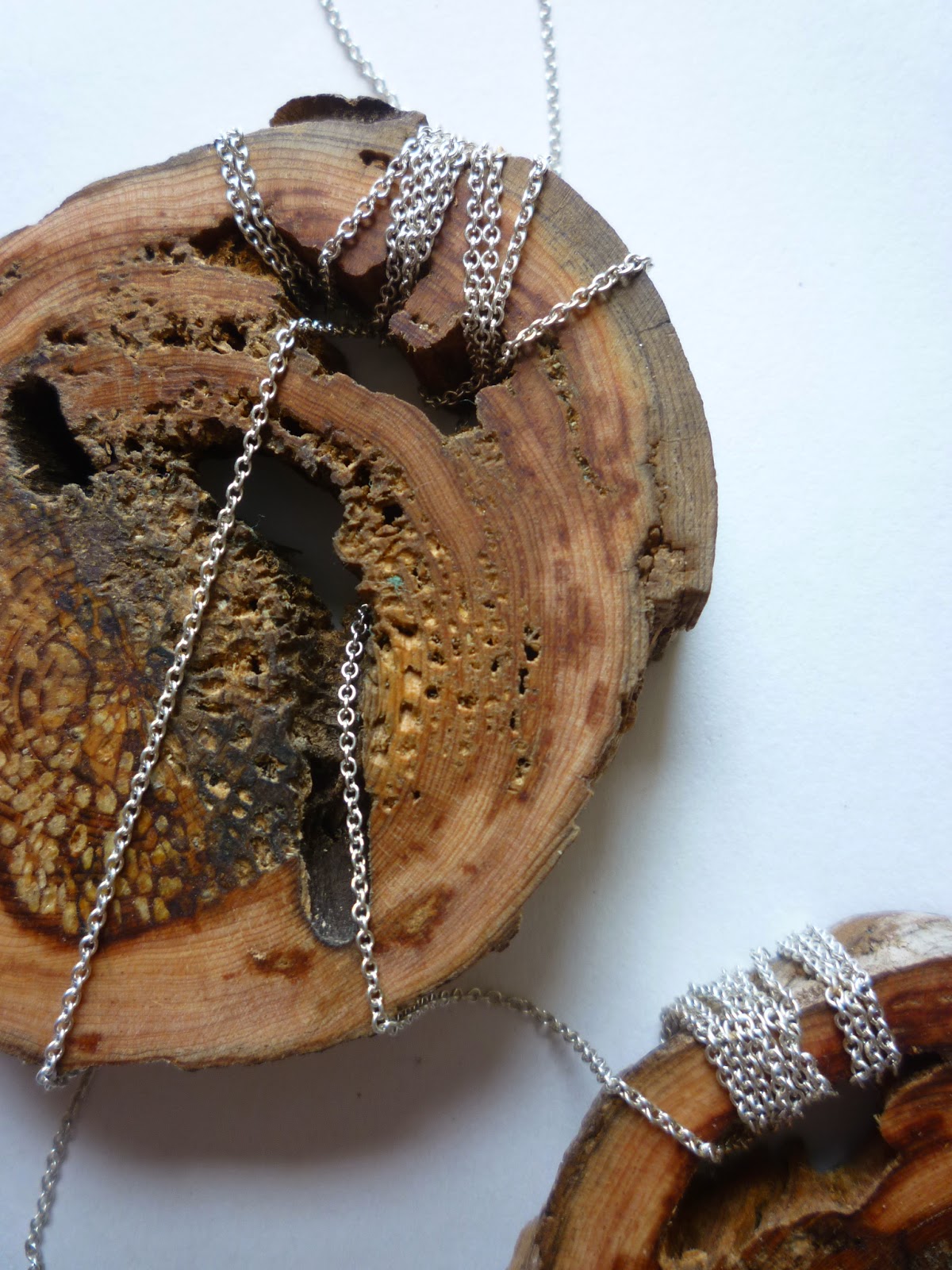
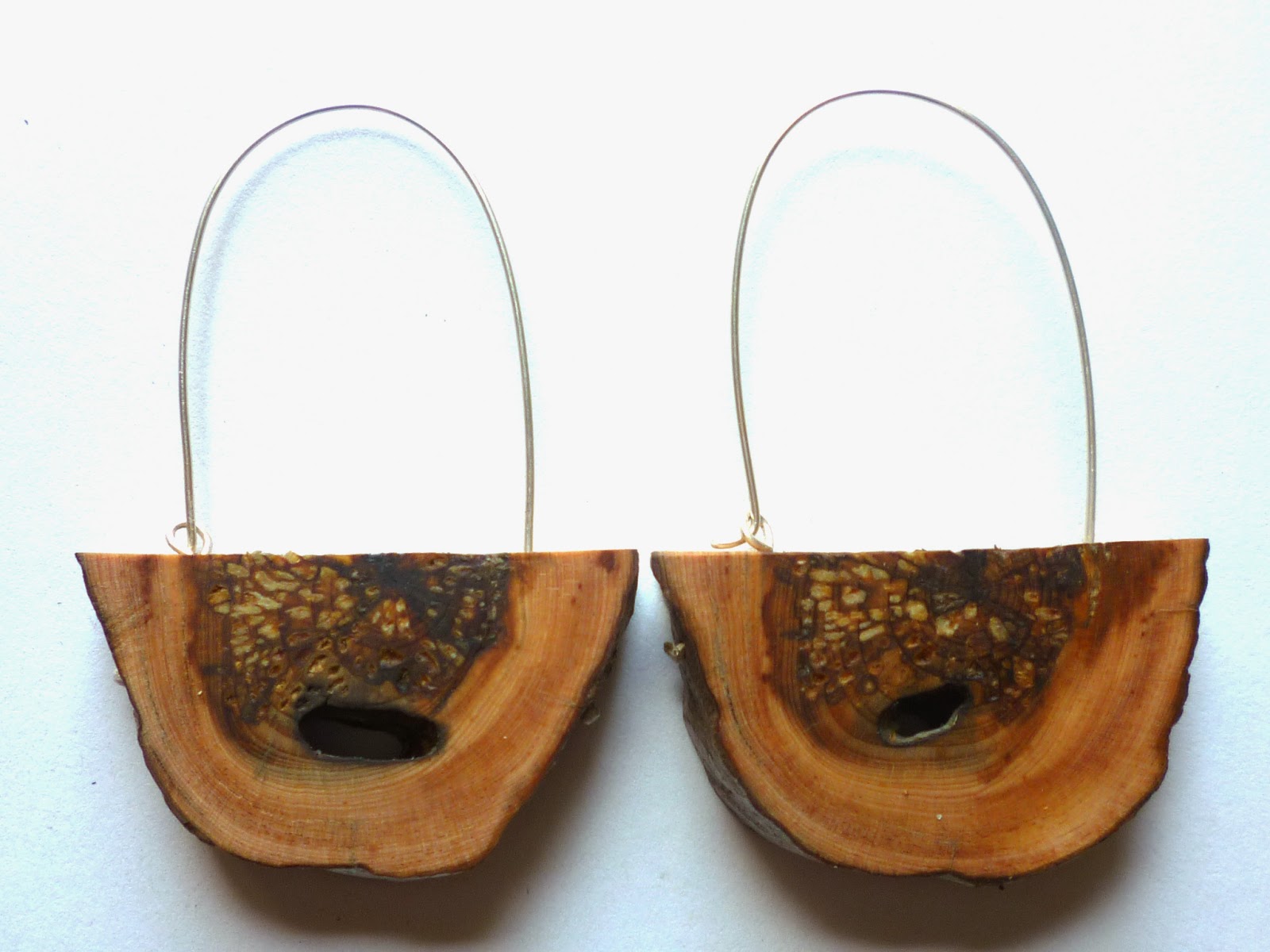
I found a great piece that measured about 8cm in diameter with weathered, sun bleached bark that I thought could be interesting to work with. To my delight, when I started slicing it on the band saw, the interior was just, if not more, interesting combining beautiful wood grain with interesting patterns eaten out of the wood by insects.


I was interested to see what would happen if I combined the sliced wood with precious metals such as sterling silver chain. The chain began to represent all sorts of things, like the thick heavy chains that are used to keep the cars of the old bush tracks. And through using such fine chain, it also started to talk about the delicate balance of nature. 


A Stitch in Time

A stitch in time (detail)
I created a needle by soldering a length of sterling silver wire to the chain to assist with threading the chain through the slices of wood. Following on from my thoughts about time and the environment, this became a conceptual piece called 'a stitch in time'. I decided to leave the needle attached as part of the finished piece.

Hanging on by a Thread

Hanging on by a Thread (detail)

I also finely sliced and re-threaded a selection. They move nicely when worn and made a lovely soft rattle when moved.


I experimented and made some large brooches. 


And also some earrings. These are the beginnings of a new line of jewellery and can be bought in my online store


Monday, 29 October 2012

Finalist for Goulburn Regional Art Gallery Award

Nest, 2012, Constructed textiles. 16 x 13 x 7.5 cm
Photography by Art Atelier


Ive been selected as a finalist for the 2012 Goulburn Regional Art Awards.
Squee!
Winners will be announced at the opening on Thursday 22 November.
Fingers crossed
x

Friday, 17 June 2011

Interwoven Exhibition at Gaffa Gallery, Sydney


My work has been selected to be part of Interwoven, an annual exhibition curated and coordinated by the Design Institute of Australia.


I drove up to Sydney on Wednesday to set up my works for the show. I was allocated a small room which had three walls - I decided to transform the space into a Lounge Room using my fabrics, as curtains, upholstery fabric, cushions, lampshade and as wall art.

Three of my designs are featured: Gingko; Knit; and Cloud stitch.

To make the fabric lengths look more like curtains I hung an old stained glass window between one pair (above).

And a small painting of the view from my kitchen window between the other.

I also commissioned an Creatif Upholstery to transform an old chair I found using some of my knit fabric - he did a fabulous job! The lovely Jane from Honi and Lemon, also transformed some of my Gingko fabric into a lampshade (you can see it in the top photo - more pictures of this to come, I promise!)

The exhibition is on at the Gaffa Gallery in Sydney from 16 - 27 June 2011.


Gaffa Gallery is in a beautiful heritage listed building in the CBD and is spread over three floors. There is a small cafe on the ground floor - delicious aromas of ground coffee spill out onto the street and waft through the space - along with a divine gift store also on the ground floor. It is definitely worth a visit!

Ill be going back for the 'Meet the Makers' on Saturday 25 June 2011. Maybe Ill see you there x


LinkWithin

Related Posts with Thumbnails