Showing posts with label environment. Show all posts

Thursday, 18 December 2014

Rural Fence Studies

Following on from my residency at Hill End in 2013 I continue to have a fascination with fences. I was interested in the decorative picket fences, many of which in the town were particularly old and were made using shapes and designs that are no longer in use. I photographed and shared some of them with you in a previous blog post


Since then, the structure of the fence has been appearing in my artworks. First as a ring design, then a brooch and finally a necklace


Over Christmas I had the opportunity to go home to Australia and one of the first things I did was to photograph the Australian landscape and admire the rural and rustic fences.


I particularly enjoy the details of how the wire is attached to the posts and the weathering that occurs from being exposed to the harsh Australian elements. 


These images are going to be the starting point for my MFA work for this semester. The theme is The Body as Landscape and I am looking to create jewellery that interacts with the body based on the idea of fences and gates. 


I love the golden tones of the setting sun against the tall grasses in the paddock. Interestingly this image serendipitously (accidentally) sums up my current interests: communication (telegraph pole and letter box), remote rural landscapes and fences. 

Thursday, 26 June 2014

Material Matters: Foraging for wood

I got such great results from slicing into found pieces of wood (see last weeks post about wood and resin) that I decided to continue working with this method of using wood collected in the bush.

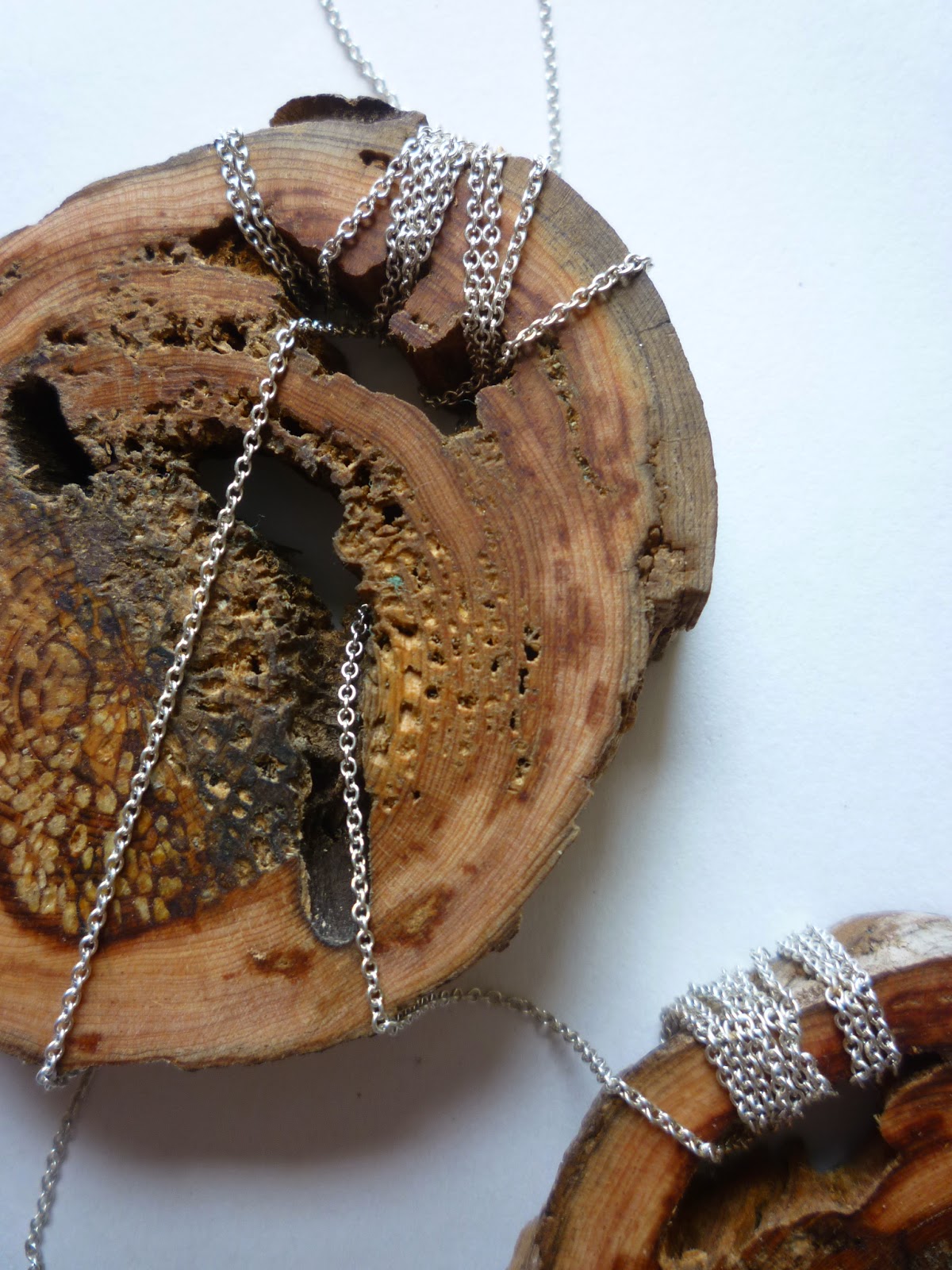
I found a great piece that measured about 8cm in diameter with weathered, sun bleached bark that I thought could be interesting to work with. To my delight, when I started slicing it on the band saw, the interior was just, if not more, interesting combining beautiful wood grain with interesting patterns eaten out of the wood by insects.


I was interested to see what would happen if I combined the sliced wood with precious metals such as sterling silver chain. The chain began to represent all sorts of things, like the thick heavy chains that are used to keep the cars of the old bush tracks. And through using such fine chain, it also started to talk about the delicate balance of nature. 


A Stitch in Time

A stitch in time (detail)
I created a needle by soldering a length of sterling silver wire to the chain to assist with threading the chain through the slices of wood. Following on from my thoughts about time and the environment, this became a conceptual piece called 'a stitch in time'. I decided to leave the needle attached as part of the finished piece.

Hanging on by a Thread

Hanging on by a Thread (detail)

I also finely sliced and re-threaded a selection. They move nicely when worn and made a lovely soft rattle when moved.


I experimented and made some large brooches. 


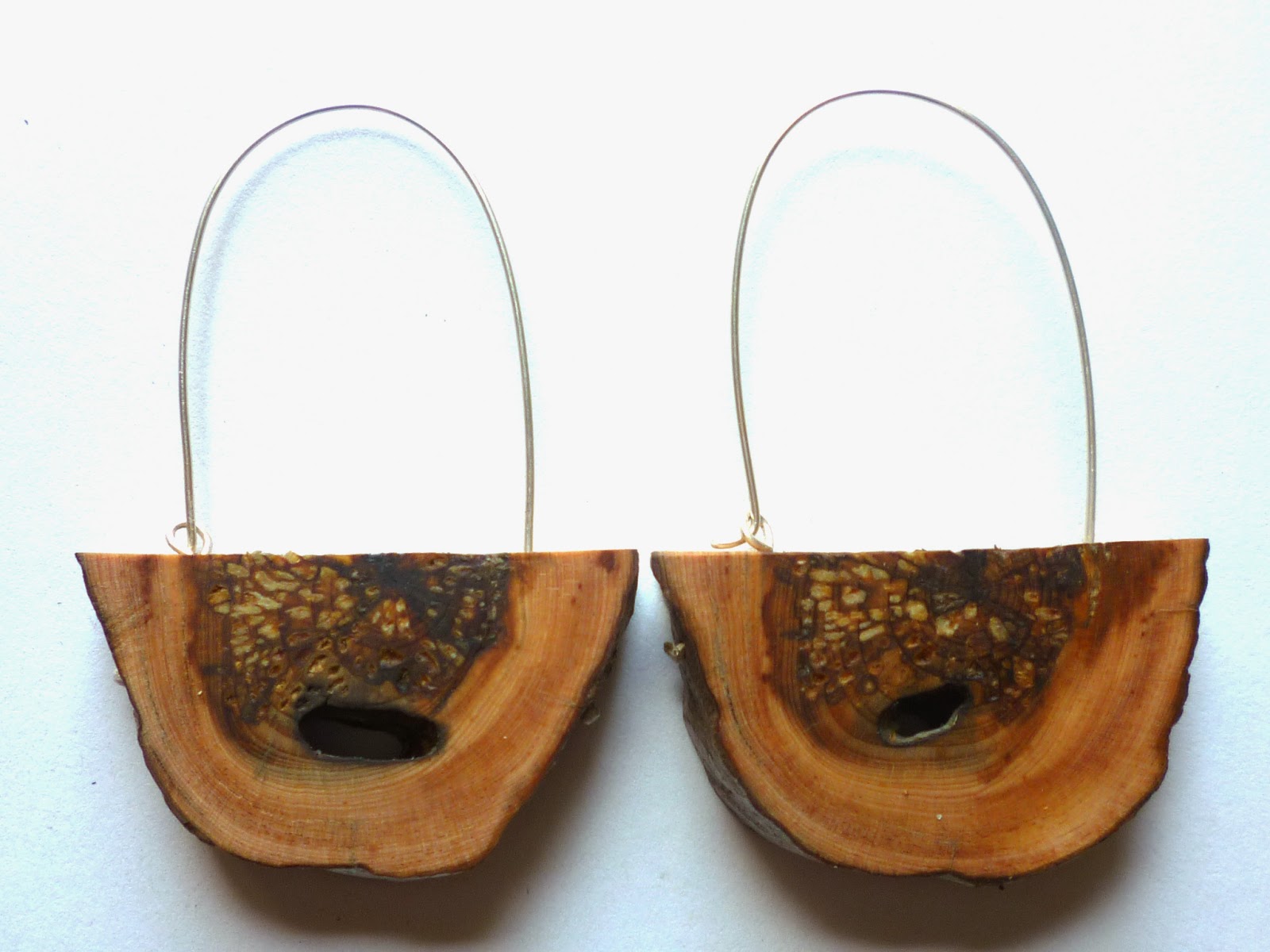
And also some earrings. These are the beginnings of a new line of jewellery and can be bought in my online store


Thursday, 8 May 2014

Completed Basket Rings displayed within Ceramics

Basket Rings. Photography: Christina Arsenault
A couple of months ago I shared with you the beginnings of a new series of work: baskets that are woven in metal and attached to rings, and more information on the concept behind these pieces can be found here

Pioneer Landscapes. Photography: Christina Arsenault

Initially they were designed to be displayed within the context of larger blocks of clay. (Further information on this concept can be found here). 

Salt of the Earth 1. Photography: Christina Arsenault

Salt of the Earth 2. Photography: Christina Arsenault
Although I also like them displayed without the ceramic pieces and just in the engraved pebbles that support them, as seen in the top image.


Thursday, 20 February 2014

In the studio: slip casting and a change of direction

I have spent the past couple of weeks experimenting with different ways of making, and decorating  slip cast bowls.

Bowl mould circa 35cm dia.
Various methods of decoration included painting coloured underglaze directly onto the plaster bowl mould (above) or onto a flat slab, which was then transferred to the bowl mould (below). A layer of cheese cloth was embedded in the slip which provided strength whilst transferring the clay slip from the flat slab to the bowl mould. The cheesecloth then burns away during the firing process.


I also explored different methods of colouring the slip and ways of layering the colours into the moulds.


Unfortunately the results always ended up like this:


Breaking whilst drying in the mould, breaking during the bisque firing, and the one that made it through to the glaze fire also shattered.

I decided that the universe way trying to tell me to work in a different way, so I have changed my direction completely, and have started to make bowls in a much more solid form.

Geology slab bowls roughly measure 20 x 20 x 30 cm

The idea is that they look like they have been roughly hewn from the ground, with a bowl hollow carved into the 'rock'.


This then led to the idea of creating strata layers within the rock-like slabs. I added red iron, raw sienna, and yellow ochre to the clay.


The result is a much more substantial bowl, and Im excited in the direction my work is taking.  

Fingers crossed it survives the firing. Next, to experiment with glazes that replicate rust!


Thursday, 2 January 2014

Public Art: Curtin Shopping Centre ACT

The Christmas and New Year holidays are always a good time to catch up on all those things I have been meaning to do, but never quite seem to find the time.

I was sorting through some boxes of my art stuff that was packed away before I moved to London (over ten years ago now) and I found images of some of my old artwork. So I have been updating my website.

One of the first projects I embarked upon after graduating from Art School in 1999 was a collaboration with artist, Matthew Harding to create public artworks for the Curtin Shopping Centre, in Canberra, ACT.

stained glass mosaic pedestal 
Canberra is the bush capital of Australia, with corridors of native bush that lead right into the city. Due to this there is an abundance of native wildlife and the variety of birds is simply delightful. This became the theme for the project, and we called it 'Flights of Fancy'.

Honey Eater stained glass mosaic pedestal

Working with images of birds: kookaburra, galah, rosella, blue wren, honey eater to mention a few, we created stained glass benches, designed cast bronze feather inserts into the paving, laser cut and powder coated steel banners, bin surrounds and drain grates, printed textile banners, and hand carved wooden play sculptures.

If you would like to see more visit my website


Thursday, 7 March 2013

Hill End Residency

Its official! I have been selected to be an artist in residence as part of the Hill End program -  Im so excited as its considered to be one of the best residencies in Australia (according to Artshub).

image courtesy of theage.com.au
Its such an interesting looking place full of beautifully preserved buildings left from an 1800's gold rush in the area, when a 286kg nugget of gold was found.

image courtesy of simonbeedle.com
I will be following in the footsteps of some of Australia's great artists. In the late 1940's Donald Friend and Russel Drysdale discovered the town and Donald Friend became so enamoured with the area that he ended up living here for a number of years. During this time he was visited by other great artists such as Margaret Olley, Jeffrey Smart, Jean Bellette and Paul Haefliger. Later the region inspired Brett Whitely, John Olsen and a number of my contemporaries. 

Russell Drysdale, Hill End, 1948
Image courtesy of www.geelonggallery.com.au 
Artists Jean Bellette and Paul Haefliger also lived in the area. It is filled with relics from their time ( they moved to live overseas with the intention of returning regularly to the cottage, as a result it remains largely unaltered with works of art, books and furnishings that echo their presence.)

Image courtesy www.hillendart.com.au
image courtesy www.homelife.com.au 
Im looking forward to continuing my investigation of early Australian pioneering times whilst at Hill End.


LinkWithin

Related Posts with Thumbnails