Showing posts with label Australia. Show all posts

Friday, 16 June 2017

PIN 7 exhibition at ANCA Gallery, Canberra

#178
Felt, cotton, stainless steel wire, purple turquoise

I am delighted to share with you that my work will be featured in PIN 7, is the seventh annual brooch exhibition at ANCA Gallery in Canberra, Australia. The pins continue to explore the theme 222 Grips for a stone, a 2 year fascination and investigation of different ways to 'grip' a stone. In this part of the series, the stones are semi-precious, and a variety of stitching methods have been used to fasten them in place.

# 174
Felt, cotton, stainless steel pin, quartz crystal
The concept of reducing scale and honing in on a wearable miniature platform appealed to artists from a broad range of practices including sculptors, printmakers, painters, ceramicists, silversmiths, machine makers, photographers, wood workers and glass artists. Following the success of the
inaugural exhibition ANCA ran ‘PIN’ exhibitions in 2012 (rePIN), 2013 (PINup), 2014 (PINHaH4), 2015 (sPIN) and 2016 (PIN SIX).
 
#175
Felt, cotton, stainless steel wire, opalite 
ANCA Gallery is running this hugely popular exhibition for the seventh time in 2017. PIN 7 will be exhibited at ANCA Gallery from Wednesday 28 June to Sunday 9 July 2017. 
#177
Felt, cotton, stainless steel wire, quartz druzy and Nova Scotian pebble


Thursday, 2 April 2015

Patchwork Fence (working title)

One of the things that I love about farm fences are the ingenious methods that they are fixed and repaired. Generally using little more than a bit of wire, they are stitched and patched to mend the holes.

Inspired by these methods I created a patchwork fence 'necklace' using fine and sterling silver.

Photography by Nasia Vayianou  

The fences were constructed exploring different methods such as fusing (where the silver melts together to join rather than the use of solder to 'glue' it together), milling the silver so that it is almost as thin as aluminium foil, piercing and weaving. 


The milled silver has a lightly textured surface.


When worn on the body it has a certain 'armour' like quality, and it reminds me a little of the notorious bushranger, Ned Kelly's suit of armour. 

Image from National Museum of Australia


Thursday, 5 February 2015

Runcible Spoon

Our first big project for Advanced Techniques Jewellery class was to make a Runcible Spoon.

Runcible was a term first coined by Edward Lear in 1871 in the poem The Owl and the Pussycat in the third verse.

They dined on mince, and slices of quince, 
Which they ate with a runcible spoon;   
And hand in hand, on the edge of the sand, 
They danced by the light of the moon, 
The moon, 
The moon, 
They danced by the light of the moon.

It is a nonsensical term and we were asked to design a spoon for a nonsensical purpose, which included a bezel setting.

With my interest in pioneers and landscapes I decided it could be fun to make a mini shovel which could for digging yourself out of trouble, or perhaps digging yourself deeper into trouble. Playing on the colloquial saying 'keep digging'.


Of course, not content with using hard stones which are easier to set (because they don't break) and only silver, I decided to incorporate opals I had bought in Australia at Christmas. I wanted to use opals because they are uniquely Australian, they are my birthstone, and they are made up mainly on solidified water. They are also considered a soft stone, and will chip easily.


I also wanted to make the bezel setting out of gold, because the warm colour of the metal enhances the colours in the opal.

Combining silver and gold was a new experience for me. And it took quite a few goes to get it right. At first I was using 22k gold solder to try and attach the bezel, but all I managed to do was melt the silver plate. After talking to a couple of established jewellers, they all suggested that I use silver solder instead. I did, and had a much better result. Yay! 


The shovel idea originally was going to be attached to a stick, but as the idea evolved it turned into a brooch-like pocket watch. There the handle can be attached to your sweater, and the chain is long enough for the shovel to be placed in the pocket. 

I ended up making 3 handles to get the perfect result (I didn't like the pin connection on the first one, and in the second one the stone chipped) but during the process I have ended up with a series of brooch-like pocket jewellery.

The first is the shovel, the second is a pocket thimble/bucket and the third handle is going to be attached to a handkerchief (which is still in the process of being made).

Image by Deng Chen


Thursday, 25 December 2014

Fence Studies: country town

My studies of gates and fences continues, this time focusing on the wrought iron gates found in a country towns across rural New South Wales.


Wrought iron is no longer produced on a commercial scale. They retain that description because in the past they were wrought (worked) by hand.


The word "wrought" is an archaic past participle of the verb "to work," and so "wrought iron" literally means "worked iron" as manufactured by a blacksmith.


Cast iron methods have been used since ancient times in China, but was not introduced to Western Europe until the fifteenth century. 


Wrought iron reached its peak in the 18th century however cast iron and cheaper steel caused a gradual decline in the manufacture of wrought iron. 


Mild steel is now the main material used for 'wrought iron' gates, mainly because true wrought iron is limited in its availability and generally the wrought iron available today is from reclaimed materials such as old bridges and anchor chains dredged from harbours.


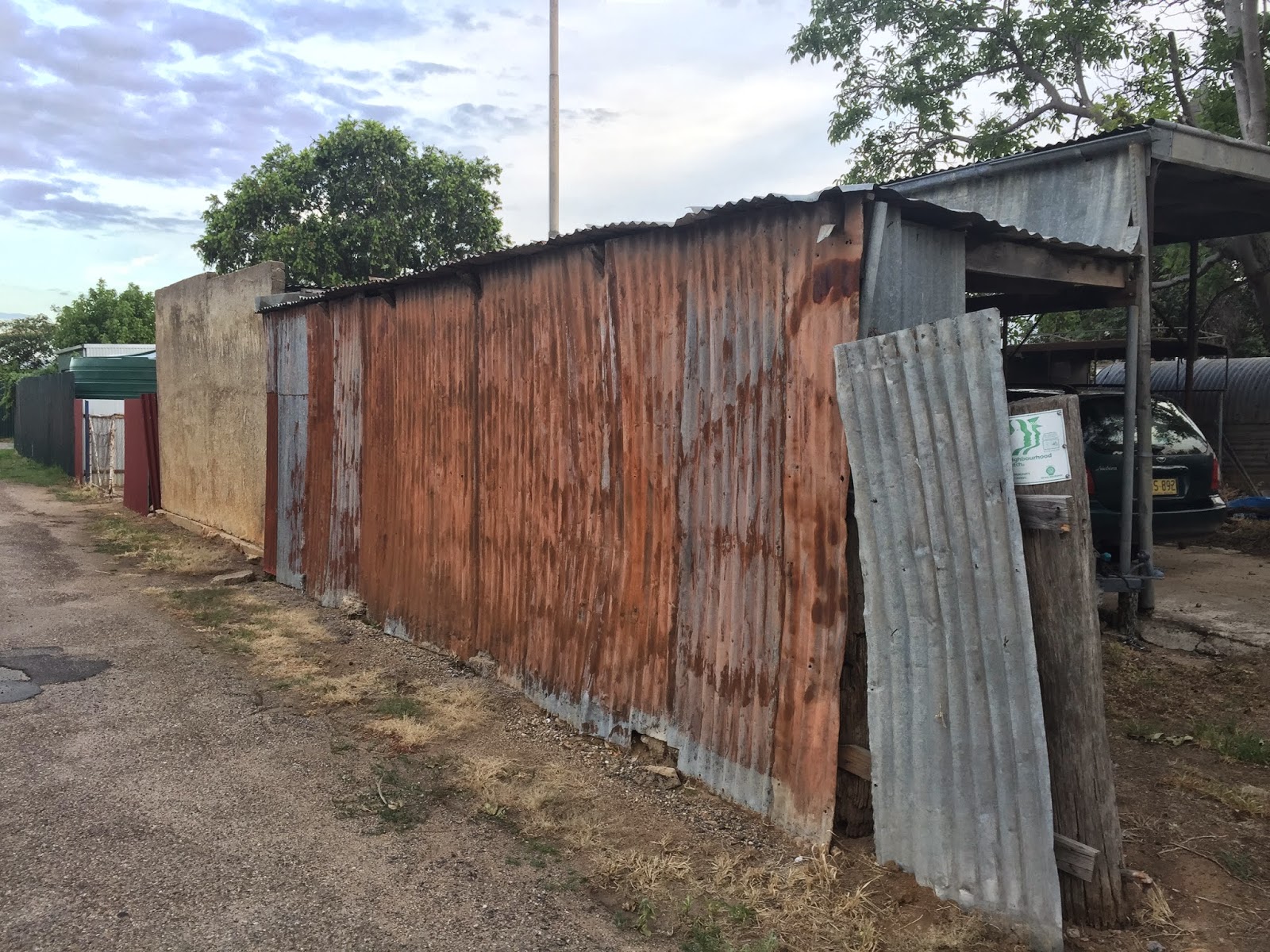
One of the towns where I did photographic studies also has a number of lane ways, which I can only assume were for the removal of waste from outhouses. Strolling along these lanes I found a number of interesting ways of fencing boundaries.


It also provided glimpses into backyards.... something Im always interested to see. There was also an abundance of fruit trees laden under fruit - particularly apricots. I have never seen such big large fruit in my life! 


This last image looks like an original wrought iron fence, it was found near a railway station. I particularly liked the way it was held together with metal pins. 

Thursday, 18 December 2014

Rural Fence Studies

Following on from my residency at Hill End in 2013 I continue to have a fascination with fences. I was interested in the decorative picket fences, many of which in the town were particularly old and were made using shapes and designs that are no longer in use. I photographed and shared some of them with you in a previous blog post


Since then, the structure of the fence has been appearing in my artworks. First as a ring design, then a brooch and finally a necklace


Over Christmas I had the opportunity to go home to Australia and one of the first things I did was to photograph the Australian landscape and admire the rural and rustic fences.


I particularly enjoy the details of how the wire is attached to the posts and the weathering that occurs from being exposed to the harsh Australian elements. 


These images are going to be the starting point for my MFA work for this semester. The theme is The Body as Landscape and I am looking to create jewellery that interacts with the body based on the idea of fences and gates. 


I love the golden tones of the setting sun against the tall grasses in the paddock. Interestingly this image serendipitously (accidentally) sums up my current interests: communication (telegraph pole and letter box), remote rural landscapes and fences. 

Thursday, 11 December 2014

End of Semester Summary

My first semester in the MFA program for studio was with Professor Gary Markle. Gary is the Head of the Fashion studio at NSCAD and he has extensive experience working in New York in fashion, film and sculpture. He was the ideal professor to work with given my interdisciplinary nature and desire to explore ideas across a range of materials.


Lichen was the launching point for a series of investigations and I represented shapes found within the lichen using paper, the lids of tins and enamel (a whole blog post was written about the enamel necklace here). The pieces also continue to reference my interest in pioneers and the isolation they experienced.


Continuing to explore my interest in women's domestic objects I made some thimbles and experimented combining porcelain with crochet and gold lustre.


Continuing to play with domestic kitchenware I was interested to see what happened when you filled the void with rocks, thinking about sense of place and your ties or attachments to a geographic location. 


Living in Canada enables me to objectively look at my Australian history and heritage. I am interested in how our ties to the past inform our present and I am exploring this through the imagery of cameos, chain and branches.


This final piece is still in the middle of being created. Originally a porcelain tea cup, it has been broken and pieced back together. All attached by a silver chain. Here I am interested in the notions of sentimentality and how we place such importance on fragile objects. 

All these ideas seem quite disparate at the moment although I am hoping to distill their essence in my next semester next year. Its going to be quite the journey! 

LinkWithin

Related Posts with Thumbnails