Showing posts with label Nova Scotia. Show all posts

Friday, 4 May 2018

The Cat with the Mona Lisa smile

Mr Whiskers by Ruby
Acrylic on Canvas
2018

My youngest student Ruby has been working on a painting of her cat, Mr Whiskers, for the past month. 

This painting explores colour theory and she choose complimentary opposites on the colour wheel (orange and blue) to understand how placing a cold colour next to a warm colour makes some things recede whilst other parts of the painting pop out. 

The distinction between warm and cool colours has been important since at least the late 18th century. The contrast is related to the observed contrast in landscape light, between the warm colours associated with daylight or sunset, and the cool colours associated with a grey or overcast day. Warm colours are often said to be hues from red through yellow, browns and tans included; cool colours are often said to be the hues from blue green through blue violet, most greys included. 

Many artists use this to lead the eye around the canvas and give their paintings depth. For example, Vincent van Gogh used this technique often in paintings often using bright blues next to clear yellows for vibrancy. 


Thursday, 22 October 2015

Odradek's Cousin?

I was riding along the street enjoying the Autumn sunny weather when suddenly I noticed an object in the street. Squashed, you could see the indents in the metal and the plastic which demonstrated how much force the object had experienced whilst lying on the road. 

Interestingly the red lipstick 'bled' from within the tube, and had smeared on the outside. How very human-like! I was immediately intrigued by the object, and delicately picked it up and carefully carried it back to my studio.

Squashed lipstick - could it be Odradek's cousin?

It got me thinking about 'things' which is a continuing internal dialogue I am experiencing at the moment, having been totally immersed in my theory class which is about the same topic - 'Things'.

Some of the heady questions we have been discussing lately are whether it is possible to kill a thing by naming it? And this made me think about how we personify objects.

There is an interesting short story written by Franz Kafka who wrote about Odradek - an object that defies description that lurks in the corridors of the home, an undefinable object that has been anthropomorphised and has been given the human qualities of talking, laughing, and lurking. Whilst it is not possible to define exactly who or what Odradek is, one possible interpretation is that Odradek represents any useless, harmless object that is kept around for no reason. 

In a sense my found object, the squashed lipstick, is a kindred spirit to Odradek who was found on the street and is currently lurking in my studio. Who knows what adventures it will get up to next? 

Despite its current form, it is likely that this object will outlive me.


Thursday, 15 October 2015

Nova Scotia in the Fall

One of my good Australian friends came to visit me and it was a wonderful excuse to see some of the wondrous glory and gorgeous colours of Nova Scotia in the fall. 

We drove through the Annapolis Valley, an area known as the main breadbasket of the province, and it still produces most of Nova Scotia's fresh produce. It is renown for its delicious crisp apples, blossoms in spring and delightful colour with the changing of the leaves in the fall.

Bella Vista

Love the architecture of the barns

Beware of dancing deers 

More fabulous farm architecture 

Fall in North America is not complete without a pumpkin (squash)
 We drove through miles of picturesque scenery, winding through hills and passing wooden churches and ended the day chatting to a pumpkin farmer who was selling his wares on the side of the road.

Thursday, 8 October 2015

Teachers Assistant: Introduction to Ceramics

As part of the MFA program at NSCAD I have the opportunity to be a Teachers Assistant. This is to observe and experience teaching in the classroom. 

The MFA program is geared towards teaching as an opportunity after graduation and there is also the opportunity to propose and teach your own course.


This semester I am the teachers assistant for the Introduction to Ceramics Class. The class is focusing on hand building and one of the first assignments was to build a wig of clay that would be large enough to fit the students head.

Below are some of the wigs before being fired to bisque firing (first firing). 


Some have been painted with coloured underglazes, which will remain that colour during the firing. 


The class is taught by internationally renown Neil ForrestNeil divides his time teaching in Nova Scotia and Scandinavia and specialises in large scale ceramics. He is particularly interested in the built environment and how ceramic sculptures interact with architecture.

Thursday, 12 March 2015

Studies of fences in the snow

My fascination of fences continues whilst I am in Canada. 


Whilst the structure of them does not differ much to that of Australian fences, I am drawn to how they look in the winter landscape. Their dark silhouettes contrast sharply with the cold white snow.


I love the monochrome palette of these images, white ground, pale sky, and everything else in shades of grey.


My exploration into fences continues into my MFA thesis in which I am researching fences in the post-colonial context.


The fence is an extension of the home delineating an area between the private feminine domestic realm and the public masculine realm outside the boundaries of the fence. The space between the house and the fence is an area where the gender roles mutate. This space is a liminal area reflecting a continual shift between masculine and feminine, public and private, past and present.

The fence symbolises ownership, boundaries, protection, inclusion and exclusion. Generally the fence is constructed consisting of vertical and horizontal planes in a three dimensional space, although it can feel illusory, with only the posts being visible, the lines of wire almost transparent and lost in the landscape. Without the weight of the shadow to enhance its presence it is insubstantial yet it can still have considerable impact on the land and the human psyche. The fence physically prevents movement in space, providing an illusion of security and restricting movement in thought, inhabiting our thinking and shaping our cultures through social restrictions.

Fences are built not for security, but for a sense of security. What a fence satisfies is not so much a material need as a mental one. Fences protect people from anxieties and fears. In this way, they are built not for those who live outside them, but for those who dwell within. In a certain sense, what is built is not a fence, but a state of mind.

The fence became a symbol of colonial plunder, promising that those who erect them have the right of territorial control. They became masculine tokens of order in the wilderness.  


Thursday, 29 January 2015

Snow Days

We seem to have had quite a lot of snow this winter.


Snow piled up on my front door step
 Apparently it is unusual to get this much and for it to stay around for as long as it has.
Under all this snow somewhere is a road


For an Aussie, this much snow is delightful and exotic. Even the suggestion of shovelling snow sounded like a fun novelty.


View looking out the window at school (NSCAD)
There are fun snow patterns too...


And after a while it starts to pile up - this is the view looking towards the NSCAD buildings on Granville St Mall.


And the snow banks on the side of the roads are also starting to get high. These ones are about my chest height, which Im guessing is about 150cm. Apparently this is usual further north in places like Newfoundland, but not here in Halifax!

Chest high snow banks at my bus stop
Sometimes there is so much snow, and the conditions are so terrible that everything grinds to a halt. It is near impossible to walk outside with the icy sidewalks and the public transport is cancelled. On these days even school is cancelled and the city shuts down!

It is quite the experience for someone who had previously only experienced extreme cold when travelling through a Russian winter.

Thursday, 11 September 2014

Cuttle Fish Bone Casting

Summer is coming to an end and Im back at school. I have just started my Masters in Fine Art at NSCAD (Nova Scotia College for Art and Design). I am undertaking an interdisciplinary approach and will be working across ceramics, textiles and jewellery. 

As well as undertaking MFA courses, I am also polishing up on my jewellery skills. Recently I have been learning how to cast shapes in silver using cuttlefish bone as the mould. Cuttlefish bone is reasonably soft and it can be easily carved, or have objects pressed into it. 

Cuttlefish bone with a fork shape pressed into it.

I experimented with a few different shapes: fork, a piece of lego fence, and a twig. I discovered simple shapes work the best (because they highlight the striations of the cuttlefish bone that occurs naturally), and so I discarded the fence and twig idea and perfected the fork shape.

Cast silver fork shapes from the cuttlefish cast

 Generally the mould has only one pour (the heat of the metal burns away the cuttlefish bone and gives off a smell similar to burnt hair). The above image shows the first pour into the mould - notice I only achieved 2 of the 4 prongs (left).  On the right shows what happens if you use the same mould again. Much of the detail has been lost. Although this time I did get the four prongs.

Lego fence cast in silver and a twig

The above lego fence and twig were earlier shapes that I experimented with. Although the fence shape was relatively successful, I found that it the lovely cuttlefish bone striations were lost and so I discarded this idea.

My finished piece, another fork, was handed in last week for marking. It was finished with Black Jax to highlight the cuttlefish ridge striations. I totally forgot to take a picture but will post one as soon as I get it back.

Thursday, 4 September 2014

The Artist's Path Article in Textile Fibre Forum Magazine

I was approached by Janet De Boer, the dynamic force behind Textile Fibre Forum magazine, to write an article on my experiences participating in the Hill End residency and international residency in Halifax, Nova Scotia Canada last year.

I wrote about how I went about achieving a successful crowd funding initiative to cover the travel costs to Canada, provided some tips on participating in and what to expect during a residency, as well as writing about the work created for the residencies. The result was a three page article that has just been published in the September edition of Textile Fibre Forum magazine. 


Click on the images for a legible version of the article.


Participating in the two residencies last year created a different path for my art career. Keeping an open mind and getting out of my comfort zone led to new opportunities and possibilities. I have been swept in directions that I would not have dreamed possible a year ago and I have met so many fabulous people along the way.

The career of an artist has many twists and turns, all of which are made possible with a curious mind and tenacity of spirit. Who knows where it will take me next? 

A big thank you to Janet and her team for including me in the magazine. X


Thursday, 7 August 2014

Feature article in Canberra Potter's Society Newsletter

Earlier this year I was interviewed by Kathryn Wells for the Canberra Potter's Society (CPS) newsletter. 

I used to have one of the lovely studios at CPS which has a lovely views and great facilities. It also has one of the most friendly and supportive environments an artist could wish to be involved with. Ill see if I can dig out some images of my studio and its surroundings to share with you. 


The article talks about the similarities and differences between the residencies, challenges I encountered, what I gained from the experiences and how it has progressed by work.


Click on the images for a readable version. Alternatively you can visit the CPS website and download a pdf version of the newsletter. Enjoy!

Thursday, 14 November 2013

Maud's House Tea Towel

Earlier in the year I ran a crowd funding campaign to assist with my travel to Halifax, Nova Scotia to participate in the Nova Scotia Centre for Craft and Design's Summer residency.

One of the rewards for my crowd funding supporters was a tea towel hand printed by me with an image of Canadian artist Maud Lewis's tiny little cottage. 

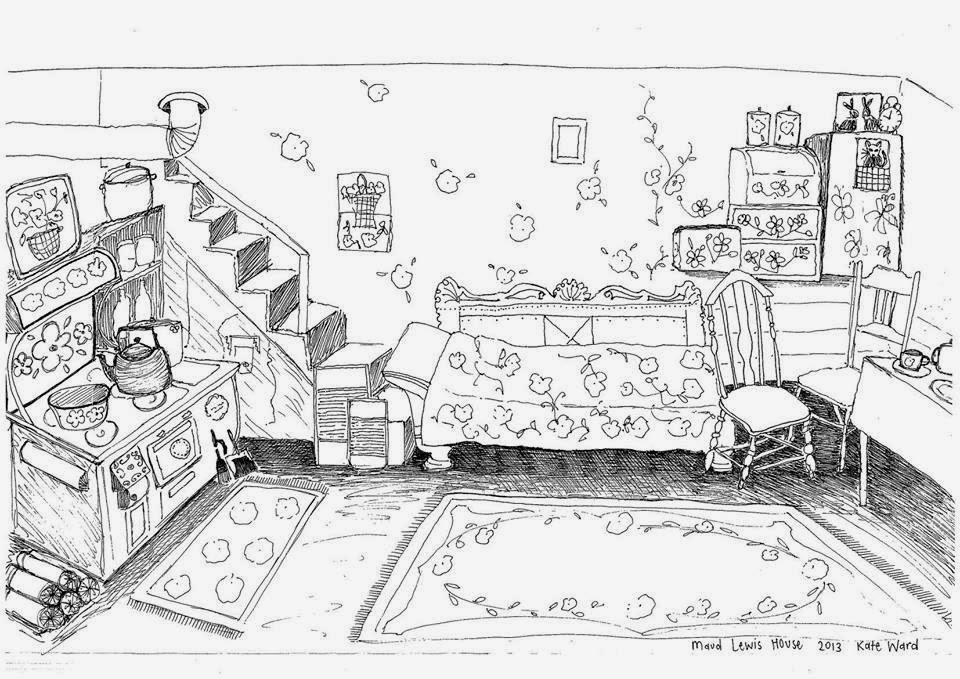
The building is so tiny and amazingly decorated all over with her folk art that her entire house is now in the Art Gallery of Nova Scotia in Halifax! Her cottage was so basic that it did not have electricity or running water and consisted of one room and an attic. As such she fitted in with my concept of pioneering women and images of her house appeared in the artwork produced for the exhibition in Halifax.

Printing up a storm at Megalo Print Studio and Gallery 
You may have seen some images of her cottage on my blog if you had time to follow my adventures - here's a link if you would like to know more about her.


Printed on 100% linen tea towels measuring 50 x 70 cm using water based permanent ink, I got carried away and printed a few extra tea towels with the Maud Lewis design. If you would like one for your collection, or a Christmas gift, you can find them in my online store.

Thursday, 31 October 2013

The Exhibition: Landscapes Ladies & Literature

Here are some images from my solo exhibition Landscapes Ladies & Literature at the Barometer Gallery in Paddington, Sydney.


It was a fabulous gallery space, with lots of natural light through two huge windows that faced onto the streets and high ceilings. The gallery was on the corner of two streets and had great street presence. 


Many people dropped in after driving past and seeing the artwork on the walls!


'Adrift in a Foreign Land' - created in Halifax, Nova Scotia
The exhibition displayed the work created on the two residencies I undertook this year: the old gold mining town of Hill End in June, and Halifax Nova Scotia in July and August 2013. All the work created was inspired by pioneering ladies in both countries.

Images inspired by Hill End onto cast porcelain bottles
If you would like to see some more images of the works created in both residencies visit my website, www.kateward.com.au 


Barometer Gallery was just around the corner from Five Ways, a well known area where five roads meet. This place has such a lovely village vibe, and reminded me a little of London. 


Great food, pubs and restaurants lined the streets. And the Jacaranda trees were in bloom. Quite delightful, creating lilac vistas and carpeting streets with purple blossoms!


And I was most taken by the Thomas Dux Grocer, a store that had a delightful assortment of delectable gourmet delights, and turns out to be an upmarket Woolworths supermarket (and much more enjoyable to shop in!)

I shopped daily at Sonoma bakery, which had a delicious assortment of sourdough breads. 

And I found the most wonderful cafe ever called Tiger Mottle. It made the best coffee and had such a great vibe.... if you are in the area I recommend checking all these places out.

Its such fun! 


Thursday, 19 September 2013

Artist spoons out experiments

A big thank you to Nova Scotia Centre for Craft and Design who lined up this interview with Arts Reporter, Elissa Barnard of the Halifax Chronicle Herald Newspaper, who is such a lovely person to talk to.

The article below is the result of our chat.... (double click on the image to read the article) 

Halifax Chronicle Herald, 18 September 2013, D3

Thursday, 29 August 2013

Exhibition: Traversing Frontiers .. four days til set up


Its the final count down with only four days to go til we set up our exhibition Traversing Frontiers at the Mary E Black gallery.

And my work is starting to come together. Exciting! Below are some images of some of the work that will be on show in the exhibition.

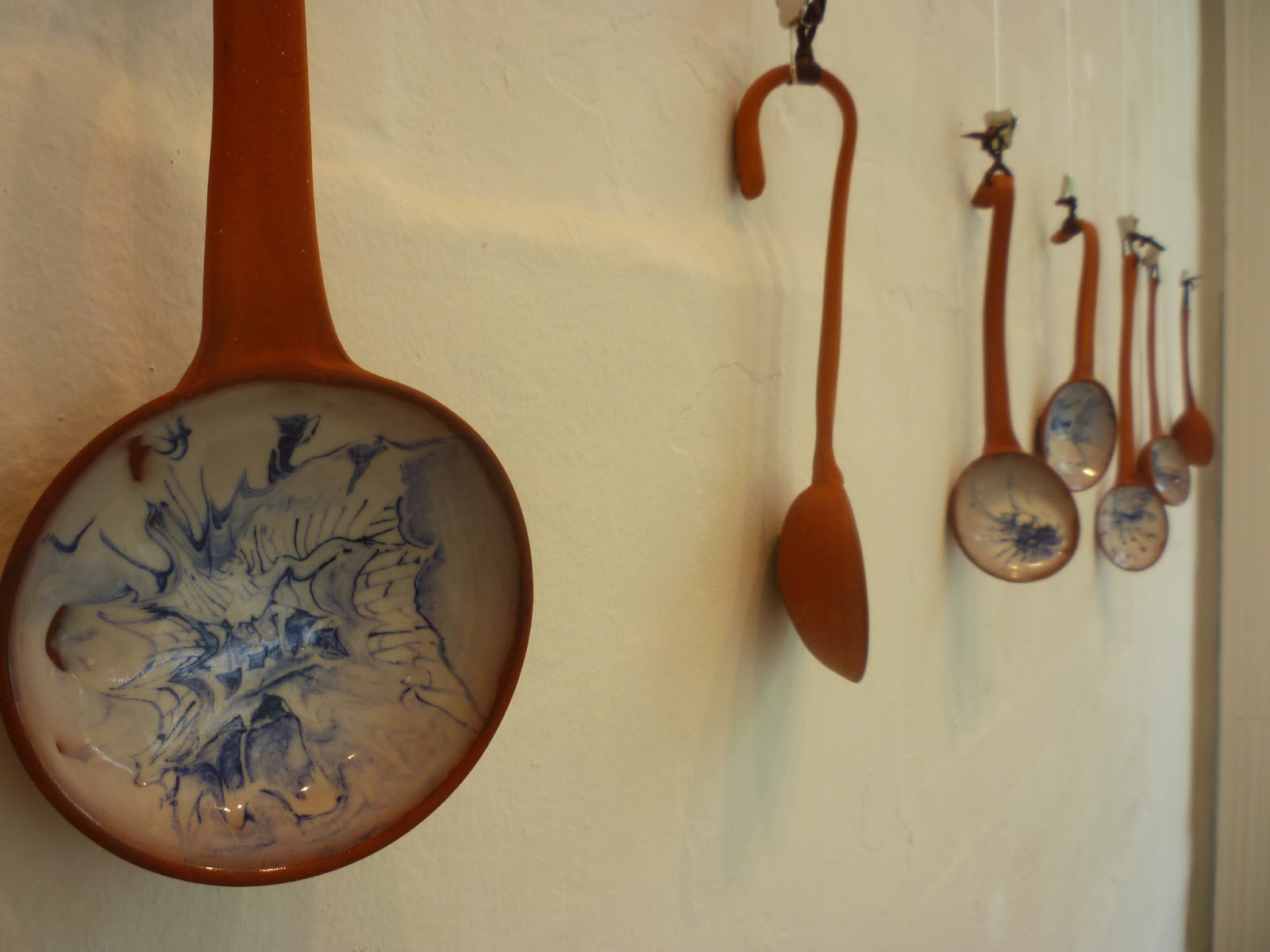
Ceramic spoons, with decals and  wooden handles

Detail: decal drawing of the interior of Green Gables

I also fired the kiln by myself for the first time on Wednesday eve. I am generally used to programmable electric kilns, so it was a new experience for me to sit with the kiln and manually increase the temperature. 


I used two different majolica glazes. Thankfully I got some great results.


Quaker Kitchen House - Majolica glaze

I have also found some time to play in the studio and work through some other ideas that are not specifically related to the exhibition. Below are some images of my favourite buildings in downtown Halifax on Barrington Street.

This is my most favourite building

It has little round windows in the turret


The Kyber Building

LinkWithin

Related Posts with Thumbnails