Thursday, 28 May 2015

SNAG Boston

I was awarded a scholarship to attend the 44th annual SNAG (Society of North American Goldsmiths) conference, Looking Back, Forging Forward, held in Boston from 20 - 23 May.

Hanging out with Ruudt

The highlight of the conference was listening to Ruudt Peters keynote presentation 2mm Squared. Ruudt's practice continually challenges peoples perceptions of conventional jewellery and he alternates between jewellery and sculpture.


It was interesting to hear him talk about jewellery as craft, and how many makers get lost in the material and forget about the concept behind the work. He believes that this is the downfall of craft, which lacks the critical thinking and theories of art.

working sketch of an idea in process

It was fascinating to see his process from sketches which make their way to a family (series) of pieces. Ruudt is always challenging himself to create new pieces by placing himself in unfamiliar environments (such as a trip to China) and working with materials he doesn't like until you learn to love them. 

He was spoke about giving space to the unconscious and he often will create 'blind drawings' to start his creative process. He will intensely research and draw relating to a particular project, and then burn them all to allow the subconscious to create. The results are always fresh and spectacular. 

One of the finished pieces
 The conference also offered professional development workshops and I had the opportunity to meet with UK artist Helen Carnac, and discuss my work. Helen provided many great insights, and suggested a number of artists to research, that would assist to progress my work. This was incredibly exciting as she approaches jewellery making with a UK perspective, which is completely different to that of North America. Interestingly, she suggested that I work with metal to make it look more fluid like textiles - which relates back to my BVA in textiles. I look forward to trying out some of these ideas in the studio.

Two artists Helen suggested I research are:

June Schwarcz - who creates soft textile looking objects using metal and enamel
Martin Puryear - a sculpture who often incorporates textile techniques to construct large objects


The Heidi Lowe gallery held a pop up exhibition in one of the hotel rooms, which was welcomed with great excitement by the conference participants. Lots of great earrings were on display and I couldn't help but buy a pair - as a souvenir of course! 


I loved the simplicity of this design by Laura Hutchcraft


There were many satellite exhibitions (and way too many to see) which also provided the opportunity to explore Boston by foot.

Boston Streets

One of the exhibition highlights was held at the Laconia Gallery. The Homework Project, invited eight metalsmith, who have a studio in their homes to create a piece per month using their homes and the space within as a source of inspiration. The results were amazing.


dryer 'felt' or 'fluff'

Old hair curlers

Bracelts made from an old sewer pipe. Brilliant!

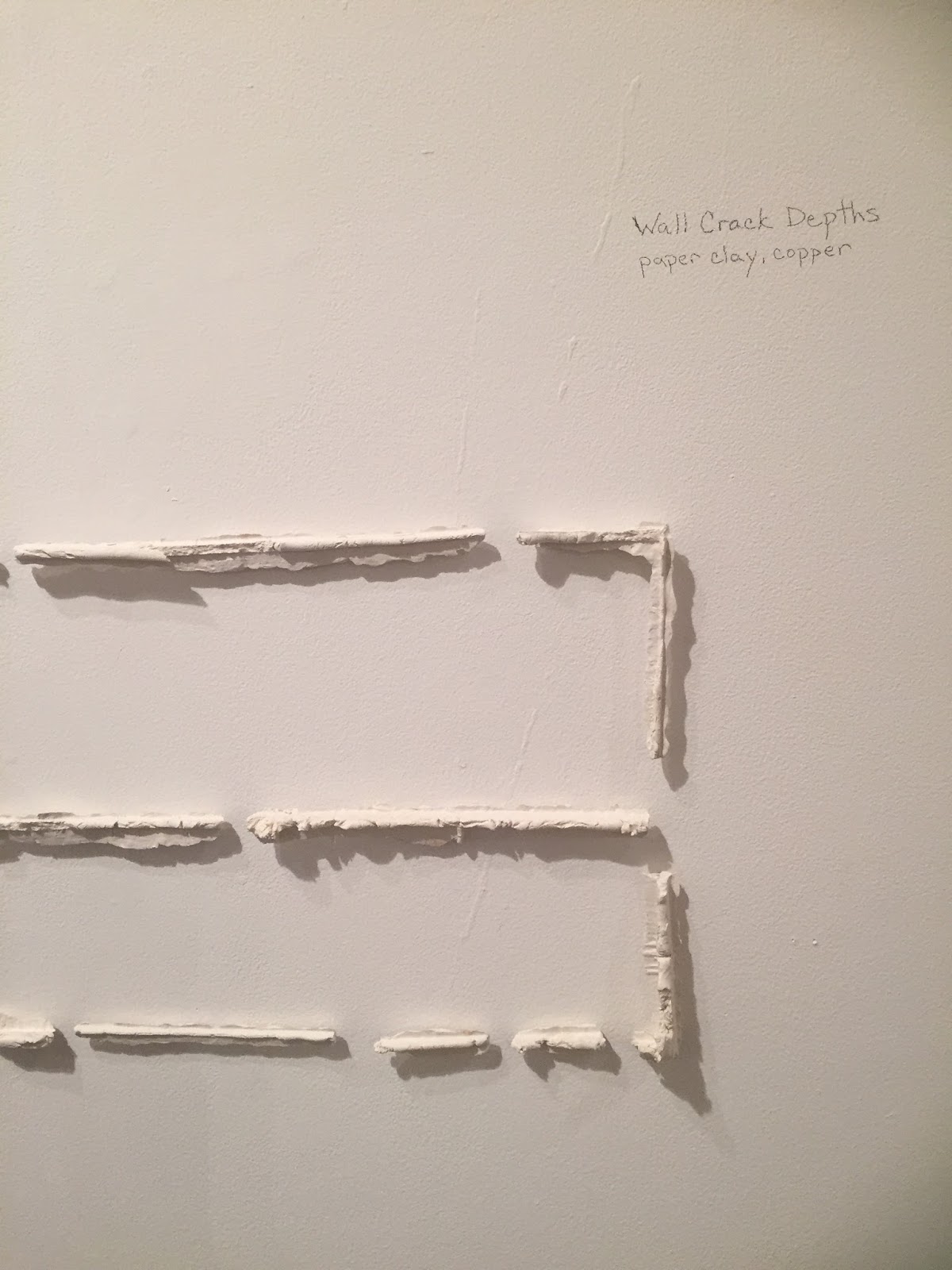
Looking at lines in the walls 


Back at the conference the vendor room was full of rocks, minerals and gems to admire, and purchase!  There were so many to choose from it was almost overwhelming.


A selection of gems I couldn't resist buying.
When the conference finished we continued our love of gems and minerals and visited the Natural History Museum at Harvard University.
Grounds at Harvard University, Cambridge

Fabulous displays of minerals
The collection was inspirational.


Thursday, 16 April 2015

Diaspora


Queen Anne's Lace is an introduced flower from Britain that can be found growing abundently in Australia and Canada. As an introduced species I see this plant as a symbol of travel with the ability to adapt to its environment. Dried flower heads have been dipped in a porcelain slip and fired, leaving behind lace like structures. Although delicate in appearance, the plant has adapted to both the cold conditions of Canada and the arid conditions of Australia.


'Diaspora' has been selected to be exhibited in BeLonging, an exhibition curated by TACA (The Australian Ceramic Association) as part of the Australian Ceramics Triennale held in Canberra in 2015. Selected artists created commentaries inspired by place.


The exhibition will run from 27 June to 11 July 2015, at the ANU School of Art Foyer Gallery, 2 Childers St, Acton, ACT 2601. 


Thursday, 9 April 2015

Pioneer Landscapes on exhibition at Craft ACT: Craft + Design Centre

Pioneer Landscapes is a selection of works created in response to my Artist in Residence at Hill End, NSW in 2013. 

Lichen Bells 2014
Silk, fine silver, enamel
Image: Art Atelier


Steel String Wood Necklace 2014
Materials: steel, cotton, wood
Image: Art Atelier

The impact on the landscape by the pioneers was evident by the scarred earth, colonial architecture and forest re-growth. I was fascinated by the bush fences in various states of disrepair and the decorative picket fences of the townships which clearly delineated ownership of space by the early colonial settlers. Despite the impact on the Australian bush by the pioneers, the resilient nature of lichen covered all surfaces. The texture and colour of it captivated me and I noticed that it grew on trees, rocks, fences and even on the sealed roads. 

I commenced a new body of work in 2014 which explores the materials and construction methods used to create these fences whilst incorporating ideas of regrowth and regeneration through the symbolism of lichen. 

Pioneer Landscapes at Craft ACT : Craft + Design Centre
Image courtesy of the Gallery

Pioneer Landscapes at Craft ACT : Craft + Design Centre
Image courtesy of the Gallery

Pioneer Landscapes at Craft ACT : Craft + Design Centre
Image courtesy of the Gallery

The experience at Hill End had a lasting impact on me and it continues to inform my work  Master in Fine Arts (MFA) degree at NSCAD (Nova Scotia College for Art and Design) in Halifax, Canada.

For more images of the exhibition please visit my Facebook page


Thursday, 2 April 2015

Patchwork Fence (working title)

One of the things that I love about farm fences are the ingenious methods that they are fixed and repaired. Generally using little more than a bit of wire, they are stitched and patched to mend the holes.

Inspired by these methods I created a patchwork fence 'necklace' using fine and sterling silver.

Photography by Nasia Vayianou  

The fences were constructed exploring different methods such as fusing (where the silver melts together to join rather than the use of solder to 'glue' it together), milling the silver so that it is almost as thin as aluminium foil, piercing and weaving. 


The milled silver has a lightly textured surface.


When worn on the body it has a certain 'armour' like quality, and it reminds me a little of the notorious bushranger, Ned Kelly's suit of armour. 

Image from National Museum of Australia


Thursday, 26 March 2015

Hemmed In

Continuing my exploration into creating fences using different mediums, Hemmed In is created incorporating textiles, ceramics and jewellery techniques.

Knitted cotton within fused silver 'gates'

The first step was to knit (with cotton) some panels of fence that are inspired by wire fences.

Knitted cotton dipped in porcelain slip

Next, I dipped the cotton in a high fire porcelain slip and I laid them out on a canvas board to dry. This worked well, but they had a 'front' and a 'back' from being dried flat. If I was to do this again, I would suspend them so that they had two interesting 'front' sides.

Painted with Cone 06 glaze

I wanted to apply gold lustre, gold leaf and decals onto the surface of them (they need a layer of clear glaze to adhere to the porcelain). So once they were fired (one firing all the way up to cone 10) I painted them with a thin layer of clear glaze.

The pale aqua are covered with clear glaze prior to firing.

I experimented with gold lustre, but wasn't incredibly happy with the results because it came out quite a dark copper gold.

I also experimented with putting gold leaf followed by decals that were fired in an enamel kiln at 1500 F degrees for a couple of minutes. The gold leaf remained light in colour and the decals were reminiscent of the blue willow ware that dates back to dinnerware of the 18th century.

Hemmed In

To attach the ceramic knitted pieces to the fence panels I used very thin silver wire to wrap them into place. I was inspired by the rustic and often ingenious ways fences are repaired. 

Hemmed In (detail)

The ceramic panels were dispersed between panels that were fused together with the fine silver wire.

I joined the fence panels together using a method used by the artist Alexander Calder, who whilst well known for his mobile sculptures, was also a prolific maker of jewellery.

He is one of my heroes because of his unorthodox approach to jewellery.

Thursday, 19 March 2015

Fence marquettes

My studies of fences in the Australian and Canadian landscape has resulted in some of the following experiments.

Woven copper, enamel
Inspired by fences in the snow

Copper Fence
inspired by the old fences in front of Colonial Buildings
A progression of the above idea
Potentially a brooch

Silver with copper rivets & knitted silver wire.
Inspired by a wire gates at Hill End

Steel wire, silver wire, glass beads
A progression of the above idea incorporating beads
and experimenting with a different netting technique


Sticks and copper wire
Experimenting with a different netting technique

Copper and cotton
Experimenting with a flat sheet and bending it
The thread just happened...

Copper
More experiments with bending a flat sheet of copper 

Thursday, 12 March 2015

Studies of fences in the snow

My fascination of fences continues whilst I am in Canada. 


Whilst the structure of them does not differ much to that of Australian fences, I am drawn to how they look in the winter landscape. Their dark silhouettes contrast sharply with the cold white snow.


I love the monochrome palette of these images, white ground, pale sky, and everything else in shades of grey.


My exploration into fences continues into my MFA thesis in which I am researching fences in the post-colonial context.


The fence is an extension of the home delineating an area between the private feminine domestic realm and the public masculine realm outside the boundaries of the fence. The space between the house and the fence is an area where the gender roles mutate. This space is a liminal area reflecting a continual shift between masculine and feminine, public and private, past and present.

The fence symbolises ownership, boundaries, protection, inclusion and exclusion. Generally the fence is constructed consisting of vertical and horizontal planes in a three dimensional space, although it can feel illusory, with only the posts being visible, the lines of wire almost transparent and lost in the landscape. Without the weight of the shadow to enhance its presence it is insubstantial yet it can still have considerable impact on the land and the human psyche. The fence physically prevents movement in space, providing an illusion of security and restricting movement in thought, inhabiting our thinking and shaping our cultures through social restrictions.

Fences are built not for security, but for a sense of security. What a fence satisfies is not so much a material need as a mental one. Fences protect people from anxieties and fears. In this way, they are built not for those who live outside them, but for those who dwell within. In a certain sense, what is built is not a fence, but a state of mind.

The fence became a symbol of colonial plunder, promising that those who erect them have the right of territorial control. They became masculine tokens of order in the wilderness.  


LinkWithin

Related Posts with Thumbnails