Showing posts with label gate. Show all posts

Thursday, 12 March 2015

Studies of fences in the snow

My fascination of fences continues whilst I am in Canada. 


Whilst the structure of them does not differ much to that of Australian fences, I am drawn to how they look in the winter landscape. Their dark silhouettes contrast sharply with the cold white snow.


I love the monochrome palette of these images, white ground, pale sky, and everything else in shades of grey.


My exploration into fences continues into my MFA thesis in which I am researching fences in the post-colonial context.


The fence is an extension of the home delineating an area between the private feminine domestic realm and the public masculine realm outside the boundaries of the fence. The space between the house and the fence is an area where the gender roles mutate. This space is a liminal area reflecting a continual shift between masculine and feminine, public and private, past and present.

The fence symbolises ownership, boundaries, protection, inclusion and exclusion. Generally the fence is constructed consisting of vertical and horizontal planes in a three dimensional space, although it can feel illusory, with only the posts being visible, the lines of wire almost transparent and lost in the landscape. Without the weight of the shadow to enhance its presence it is insubstantial yet it can still have considerable impact on the land and the human psyche. The fence physically prevents movement in space, providing an illusion of security and restricting movement in thought, inhabiting our thinking and shaping our cultures through social restrictions.

Fences are built not for security, but for a sense of security. What a fence satisfies is not so much a material need as a mental one. Fences protect people from anxieties and fears. In this way, they are built not for those who live outside them, but for those who dwell within. In a certain sense, what is built is not a fence, but a state of mind.

The fence became a symbol of colonial plunder, promising that those who erect them have the right of territorial control. They became masculine tokens of order in the wilderness.  


Thursday, 26 February 2015

Keraflex experiments

I have been wanting to experiment with Keraflex ever since I heard about it when I first studying ceramics a couple of years ago. It is super thin ceramic that comes in flat sheets (0.5mm or 1mm thick) very much like paper. It is held together with a binding agent which makes it flexible when soaked in water and it provides the opportunity to make ceramic  products which are extremely thin and light.

Recently I have been playing with it. Experimenting with stitching to hold it together to create different sorts of forms.


Stitched keraflex (white bottom left corner)
Above are some samples to see what happens when the form is held together using thread before being fired in the kiln. In this image there are also stitched cardboard and copper samples where I am experimenting with form.


Most of the stitched pieces broke during the firing. But the shards were equally beautiful and intresting shapes, so I attached them to one of my gate like structures. I anticipate that this could be a brooch. 

Despite being really thin, the material is quite strong when fired to cone 10. 

Paper marquette of necklace idea

I also experimented with making cone shapes. With the intention of making a necklace similar to the paper version above.

Keraflex cones before firing
Keraflex cones after firing with gold lustre
I like the white porcelain combined with the gold lustre. But to get gold lustre to work, they need to be glazed with clear first (fired to cone 6). In the pieces above, I glaze only the bits that are now gold, so there is also the contrast between matt porcelain and shinny gold.

I have moved on from the original cone idea, and I am enjoying working with the shards. So I am thinking that these will be broken and reassembled along the same lines as the brooch idea.


Thursday, 8 January 2015

Box Clasp Fence Bracelet

Well, there is absolutely no rest for the wicked, and school is back with a bang.

Detail of the box clasp

This semester I am continuing my studies with jewellery and I am undertaking 'Advanced Techniques' which is mainly gem setting, but it also includes making complicated clasps, including the box clasp.


As well as creating a box clasp that 'clicked' when it closes, our brief was to design a bracelet that integrated with the clasp. 

Of course, I made a large one and it is approximately 2.5cm long x 1.5cm wide. Making it larger also made it harder, for some strange reason.

Detail of the chain

I used commercial chain and threaded lengths of silver through the chain to replicate a fence like structure. It also started to look like a spine, musical notes, or the DNA structure. 

Box clasps are incredibly tricky to make, and quite fiddly. Its most likely my first and last box clasp I ever make!

Thursday, 25 December 2014

Fence Studies: country town

My studies of gates and fences continues, this time focusing on the wrought iron gates found in a country towns across rural New South Wales.


Wrought iron is no longer produced on a commercial scale. They retain that description because in the past they were wrought (worked) by hand.


The word "wrought" is an archaic past participle of the verb "to work," and so "wrought iron" literally means "worked iron" as manufactured by a blacksmith.


Cast iron methods have been used since ancient times in China, but was not introduced to Western Europe until the fifteenth century. 


Wrought iron reached its peak in the 18th century however cast iron and cheaper steel caused a gradual decline in the manufacture of wrought iron. 


Mild steel is now the main material used for 'wrought iron' gates, mainly because true wrought iron is limited in its availability and generally the wrought iron available today is from reclaimed materials such as old bridges and anchor chains dredged from harbours.


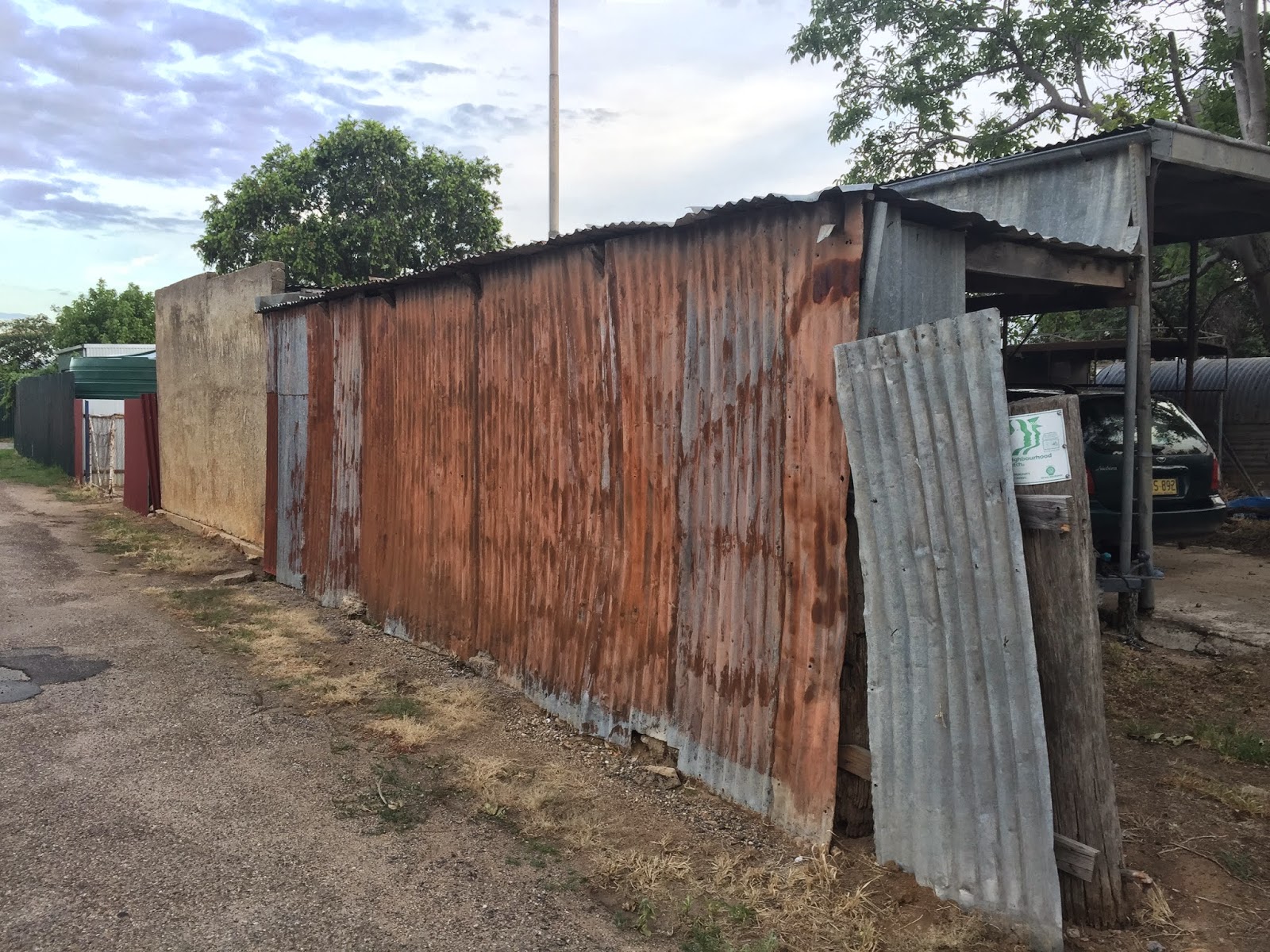
One of the towns where I did photographic studies also has a number of lane ways, which I can only assume were for the removal of waste from outhouses. Strolling along these lanes I found a number of interesting ways of fencing boundaries.


It also provided glimpses into backyards.... something Im always interested to see. There was also an abundance of fruit trees laden under fruit - particularly apricots. I have never seen such big large fruit in my life! 


This last image looks like an original wrought iron fence, it was found near a railway station. I particularly liked the way it was held together with metal pins. 

Thursday, 18 December 2014

Rural Fence Studies

Following on from my residency at Hill End in 2013 I continue to have a fascination with fences. I was interested in the decorative picket fences, many of which in the town were particularly old and were made using shapes and designs that are no longer in use. I photographed and shared some of them with you in a previous blog post


Since then, the structure of the fence has been appearing in my artworks. First as a ring design, then a brooch and finally a necklace


Over Christmas I had the opportunity to go home to Australia and one of the first things I did was to photograph the Australian landscape and admire the rural and rustic fences.


I particularly enjoy the details of how the wire is attached to the posts and the weathering that occurs from being exposed to the harsh Australian elements. 


These images are going to be the starting point for my MFA work for this semester. The theme is The Body as Landscape and I am looking to create jewellery that interacts with the body based on the idea of fences and gates. 


I love the golden tones of the setting sun against the tall grasses in the paddock. Interestingly this image serendipitously (accidentally) sums up my current interests: communication (telegraph pole and letter box), remote rural landscapes and fences. 

Thursday, 24 July 2014

Hill End Gate Neck Piece

Drawing further inspiration from my time at Hill End my next jewellery piece was informed by the etching below. 

Study of a Hill End gate. Etching 2013

The gate was constructed in wood by cutting slots in the horizontal bars, and the vertical posts were fitted into these holes. I remember being quite taken by this gate design, as I had not seen anything quite like it in my travels.

I enjoy creating marquettes before commencing a design as this helps me work out the size and how the design works in space. Its also incredibly important when working in silver as this helps save costs that may otherwise be wasted through the design process.


So I chose to recreate it in silver, drilling holes through the horizontal bars. The intention of this piece was to pivot on a central horizontal bar, allowing the vertical posts to move with gravity. Below is my first attempt.

Gate Neck Piece #1 detail

Gate Neck Piece #1
Whilst soldering, the tube of silver (second horizontal bar), also filled with solder which rendered the rotating design useless.

Back to the drawing board for attempt and design #2.

The design changed slightly and the pivoting point is now central to the neck piece. I also decided not to solder the tube to the framework, rather, slotting it in and allowing it to be held with silver wire which threads through the piece.

Gate Neck Piece #2 detail
 
Gate Neck Piece #1
The fun thing with this design is the kinetic movement and sounds created whilst the piece spins. The design reminds me a little of music written on a sheet, and the sound is reminiscent of rain on a corrugated tin roof.

Thursday, 17 July 2014

Hill End Gate Brooch

My next jewellery project was to make a brooch incorporating the newly learnt skills and techniques of cold joins or rivets. 

Continuing to gain inspiration from the gates and fences from Hill End, I referred back to one I studied during my residency, and produced a non-toxic etching from the same subject matter. I was particularly inspired by this one, as it was held together with bolts, which would have a similar 'look' to rivets when recreated in metal.

Rose Cottage, Etching 2013

Inspired, I built a marquette using wood to get an idea of size and scale. 


Hill End Gate Brooch Marquette, 2014

The final brooch was completed using copper sheet cut into strips and all joins have been riveted in place also using copper. We were also shown how to set a bezel cut jewel in between two layers of metal, and so I incorporated this technique, using a pink cubic zirconia.

Hill End Brooch, copper + pink cubic zirconia. 6cm x 6cm

LinkWithin

Related Posts with Thumbnails